Start online
Best when capital is limited and you want to test demand before committing to rent.
- Lower setup and fixed costs.
- Needs clear photography, samples, and fast WhatsApp service.
- Ads, delivery, and returns belong in every order's cost.
Choose online or a small shop, calculate the true cost of every bottle, prepare a controlled first batch, and market it without locking cash into slow stock.
Calculator defaults are editable examples, not fixed market prices.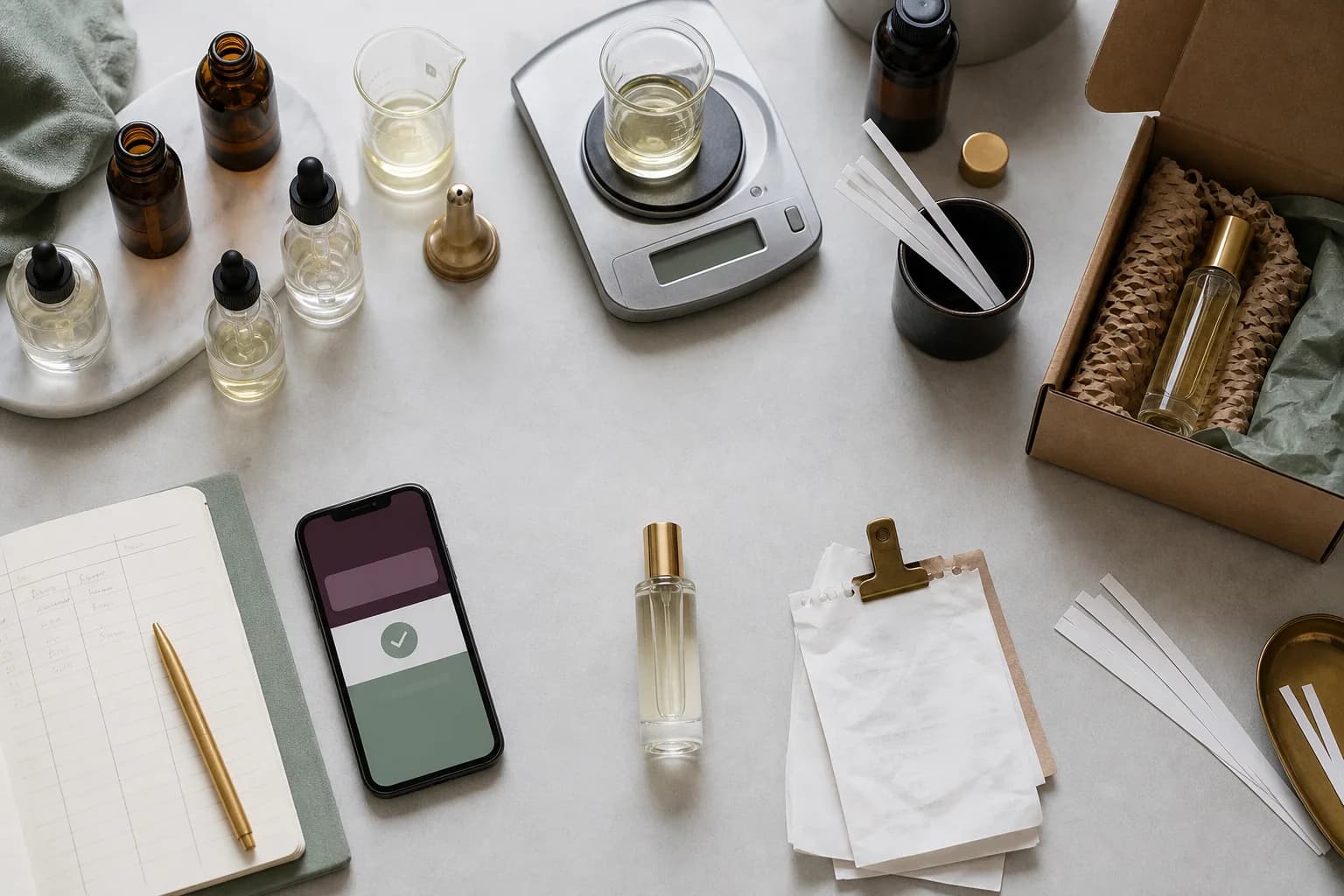
Your first decision
Best when capital is limited and you want to test demand before committing to rent.
Best when you have a proven location and customers need to smell before they buy.
Mazag rule: validate 3–5 products with real customers before buying deep inventory or signing a long lease.
The starter kit
An alcohol-based spray is the most common format, but oil-based perfume (attar/musk) is a strong, alcohol-free option in the Egyptian and Gulf market. Choose the format before buying bottles, since each needs a different bottle and filling method.
Small oil samples, perfumer's ethyl alcohol (ethanol) at 96% or 99%, distilled water if needed, and scent strips. The alcohol type matters: it must be ethanol, never methanol (toxic) or isopropyl. 99% is drier and purer, while 96% holds a little water that suits some blends.
A scale reading to 0.01 g, check weights, labels, and a log for each oil weight, lot number, and the actual alcohol used.
Useful sizes for small transfers, dedicated by material where possible. Never return a syringe that touched a blend to the original oil container.
Clean glass vessels sized for trials and batches, covers, a funnel, and a stirring tool. Leave enough working room to mix without spilling.
Start with two sizes and test the bottle, sprayer, and cap as one system, plus small samples, a clear label, and shipping-safe packing.
Sealable coded glass vessels, a dark stable-temperature shelf away from sunlight, heat, and flames, and a separate quarantine area for batches under test.
Good ventilation, a cleanable surface, storage away from heat and flames, gloves, and suitable fire protection.
A suitable outer box, protective wrap, sealing tape, a parcel scale, and courier quotes by zone and cash collection. Test a complete parcel for movement and leakage.
A practical counter, restrained shelving, clear lighting, point of sale, and signage before decoration.
Supplier and material
This business runs on compounded fragrance oil bought from perfume suppliers. Pure essential oils such as lavender or lemon are different materials with tighter skin-safety limits, and some are light-sensitive; never swap them in without checking use limits.
Test small quantities before wholesale and record the scent at opening, one hour, and four hours.
Keep the oil, company, batch number, purchase date, and price so changes can be traced.
Request available SDS, COA, and IFRA conformity information for the material or compound.
When the supplier sells oil by weight, compare cost per gram after shipping and waste, not just the supplier's bottle price.
Sales channel
Use an Instagram or Facebook page to show products and WhatsApp Business for help and ordering. Prepare a small catalog, greeting, scent-choice questions, and saved replies for price, shipping, and exchange.
Use short video for reach, choice education, and packing content, then direct interest to one ordering channel. Do not scatter orders across comments, DMs, and multiple accounts.
They help when the platform already has relevant demand, but bring commission, fulfillment, and return rules. Calculate each channel's net profit separately before copying the same price everywhere.
Move when recurring orders make catalog, inventory, addresses, discounts, and abandoned carts too difficult to manage manually. Validate demand first so subscriptions and apps do not fund an empty store.
A domain, mobile-first theme, product photos and copy, shipping, exchange, and privacy pages, delivery zones and rates, a payment provider available for your business and country, analytics, and a budget for plan, apps, and payment fees.
Before subscribing, verify a gateway available to an Egypt-based store, EGP settlement, provider charges, and Shopify's third-party gateway fees. Prepare cash-on-delivery confirmation if it fits your operation.
Build a custom site when you need an experience or integrations a hosted store cannot provide and sales can support development, security, and maintenance. Custom development is not a starting badge.
For every order record an ID, customer and zone, item and size, product and shipping totals, payment method, confirmation, tracking, ad cost, and delivered or returned status.
Refused COD deliveries in Egypt can reach 20–30% without confirmation. Confirm every order by call or WhatsApp before shipping, collect a small deposit on large orders, and follow up pending parcels with the courier daily.
A short video of each order being sealed settles any dispute about missing or broken items with the customer or the courier, and doubles as marketing content once customer data is hidden.
The workshop
Do not subtract grams from milliliters. Weigh the oil in grams from your recipe, top up with alcohol to the final volume, and record the actual alcohol used in the trial batch.
Rest and maturation
Record batch code, date, each oil weight in grams, actual alcohol used, supplier, and material lot numbers. Without this, a result cannot be repeated or investigated.
Weigh and blend the oils together first, then add the alcohol and shake the vessel well until the mix is uniform. Only then does the rest period start; resting cannot fix a mix that was never blended properly.
Keep the batch in a clean, sealed, ingredient-compatible vessel with minimal practical headspace, upright and away from light, heat, and ignition sources.
Leave the batch closed between checks and inspect at fixed points—such as 48 hours, one week, and two weeks—as comparisons, not guaranteed release dates.
Log color, clarity, sediment, separation, or leakage, and use the same number of sprays on the same blotter type under similar conditions.
After resting, natural haze or sediment can appear; chill the batch and filter it through a suitable filter until the liquid runs clear before filling, and record whether the batch needed filtering as a property of the formula.
Move forward only after appearance and scent are consistent across two checks and the bottle and sprayer pass compatibility and leak checks. Retain a reference sample from every batch.
It cannot fix undocumented material, unsafe use levels, persistent separation, or an incompatible package. Stop and investigate instead of selling in hope that time will solve it.
Heat damages perfume faster than time. Never store stock on a balcony, roof, or hot storeroom, use insulated packing for summer shipments, and retest stability if your first trials were done in cool weather.
The owner's ledger
Defaults are examples—replace them with real current quotes.
Your numbers are saved on this device automatically.
Pricing
Oil, alcohol, bottle, sprayer, label, product box, shipping protection, labor, and waste.
Ads, samples, discounts, payment fees, net shipping after the customer charge, and a reserve for refused or returned parcels.
Rent, utilities, internet, payroll, and software allocated across sales.
Do not withdraw every pound of margin; reserve cash for timely restocking.
Imported oils are priced in dollars. Price with a margin that absorbs a 10–15% rise in material cost, and recheck the per-gram price with every new purchase instead of pricing from an old invoice.
Product to customer
Name who it is for and why: quiet for work, warm for evenings, or a sample set for deciding.
Explain mood, family, occasion, testing, and expected performance without absolute claims.
Start with 3–5 products, a small waiting list, and only the volume you can deliver consistently.
Order acquisition cost, conversion, order value, repeat purchase, slow stock, and profit after ads and delivery.
Offer a paid discovery set whose cost can be credited toward a full bottle.
Ask specific questions after real use; never build trust on fabricated reviews.
Ramadan, the feasts, and wedding season are Egypt's fragrance-buying peaks, with warm scents selling in winter and fresh ones in summer. Prepare stock and content at least a month before the season instead of chasing it.
Build a broadcast list of customers who actually bought—with their permission—and message them when a new product or offer lands. It is the cheapest repeat-sales channel and converts better than ads.
A practical marketing plan
Choose one lead product or sample set, then state who it is for and why the customer should buy it now.
Required result: one offer you can explain in one sentence.Publish content that helps customers choose: scent comparisons, occasions, testing guidance, and order preparation.
Required result: questions from people who fit the offer.Ask about preferences and budget, then recommend only two options and explain the difference clearly.
Required result: a confirmed order with clear price, date, and delivery.Ask about scent, sprayer, and packaging. If the customer is satisfied, request an honest review or one relevant referral.
Required result: genuine feedback and a repeat-purchase opportunity.Help customers choose between fresh, warm, quiet, or strong directions.
Show a clean short video from measuring to packing without revealing customer data.
Explain the scent character, occasion, ideal customer, and available sizes.
Answer a real question such as concentration versus longevity or how to test a sample.
Share an approved real review and describe what the customer liked without exaggeration.
State product, price, contents, and deadline instead of using vague discount language.
This is a test allocation, not a fixed rule. Use an amount you can afford to lose and stop ads that do not produce relevant questions and paid orders.
Execution program
Pick online or a small shop, cap the budget, and define the first customer you want to serve.
Buy samples only, collect batch documents, and compare unit cost after delivery and waste.
Make two or three limited trials, lock the ratios, and give every experiment a clear number.
Test bottle and sprayer, calculate the full order cost, and set a price with a real margin.
Share samples with five relevant customers and ask about scent, price, and packaging instead of asking only whether they like it.
Take clear photos, write product and policy copy, prepare WhatsApp, and test ordering, payment, and packing yourself.
Offer a small quantity or pre-order and track questions, cost, and profit. Use a waiting list when product tests are not complete.
Compliance protects the business
Check cosmetic notification or registration, manufacturing or contract-manufacturing routes, and required package information such as ingredients, batch number, expiry or period-after-opening (PAO), usage warnings, and fragrance allergens.
Egyptian Drug Authority guideChoose the appropriate legal form, registrations, and electronic receipt or invoice obligations for your turnover.
Simplified small-business tax systemIFRA Standards may prohibit materials or restrict use levels, but do not replace local law or final-product responsibility.
Understanding IFRA StandardsThe scent itself is not legally protected, but the brand name, bottle design, and label are. Never use the original brand's name as your product name or imitate its bottle or label; sell under your own name and use wording like 'inspired by' with care.
Trademark basicsThis guide is for planning and education. It is not a permit, legal advice, or a substitute for checking your case with the responsible authorities.
Three to five clearly different, well-tested products are better than dozens that freeze cash and confuse customers.
The order may be profitable, but the business breaks even only after monthly overhead and then starting capital are recovered.
Only when the location proves relevant footfall and you can carry fixed costs while building demand.
No. Performance depends on the material, formula, use, stability, and safety limits; excess concentration can crowd a blend.
As a general frame, eau de toilette carries around 8–12% oil and eau de parfum around 15–20%, while common working ratios in the Egyptian market reach 25–30 g of oil per 100 ml. Higher is not automatically better; documentation, stability, and safety limits matter more.
MAZAG · START SMALL · MEASURE EVERYTHING